Tuesday, October 29, 2019

Intertech Medical (USA) takes next step in automation and reaps rewards.

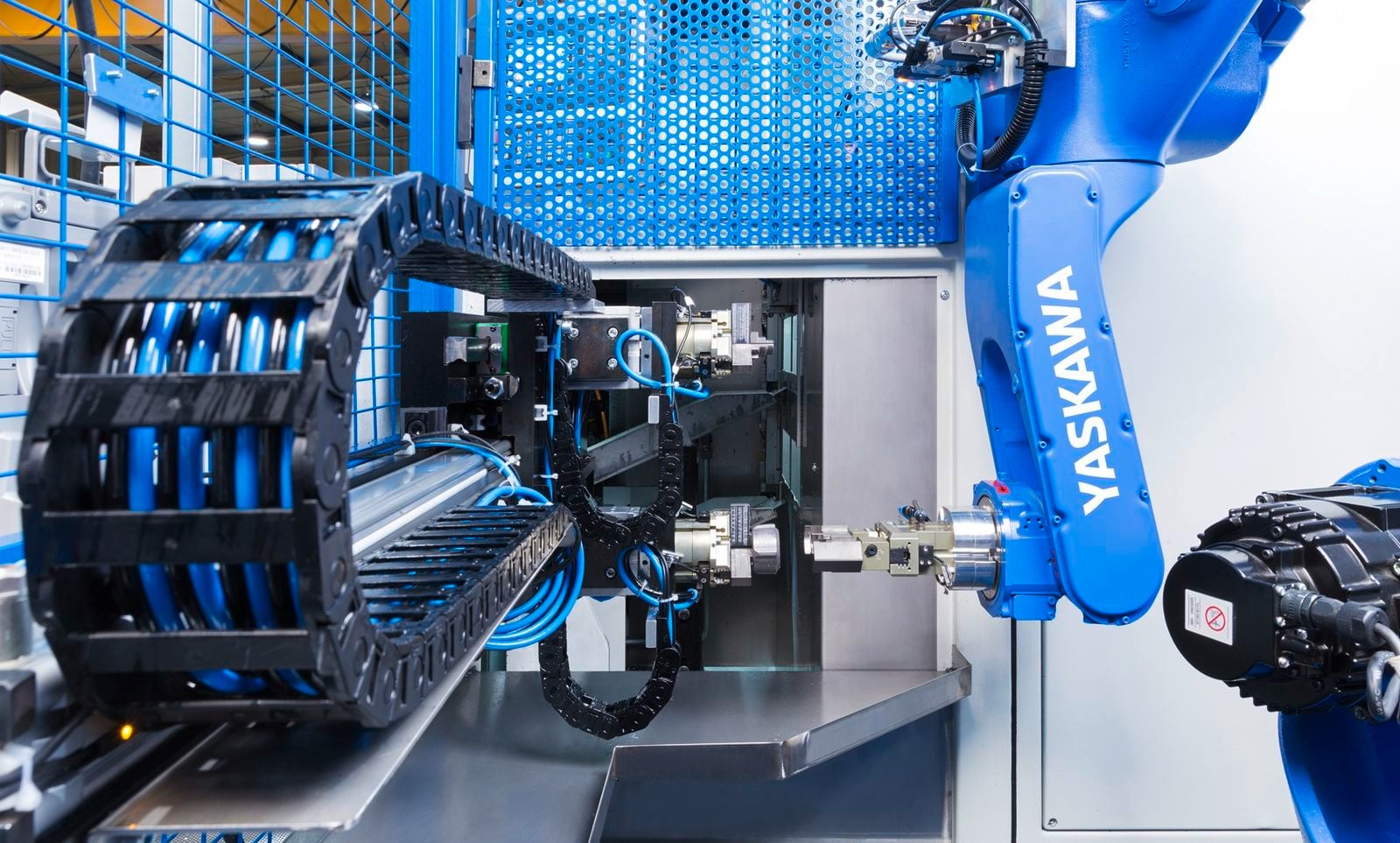

In August 2017, MAPP, the Manufacturers Association for Plastic Processors, awarded Intertech Medical first place for their 2017 Innovations Award for their work cell automating quality inspection, degating, and packaging. Intertech Medical, located in Denver, Colorado, is the region’s premier full service injection molder and contract manufacturer, specializing in medical devices.
The changes began after Intertech had been molding a medical part with complex geometry and features that was difficult to trace defects on using conventional inspection methods and sampling. With the part’s critical application and an expectation of zero defects, this was particularly problematic. After three customer complaints within six months, it was clear to both Intertech and their customer that a solution was needed.
To solve the problem, Intertech designed and built a machine-side, automated work-cell that utilized integrated process control and quality control to get to zero defects. The solution primarily centered on integrated process control, automated quality inspection, and the reduction of bioburden from part handling and packaging. Rather than just adding more operators and increasing the number of times quality inspections, Intertech took a leap forward in their automation and inspection technology and were able to achieve the best results possible.

Successful WITTMANN automation

Intertech already had robots, but the supplier they had been using was limiting their ability to program and customize their process. Knowing that WITTMANN robots had a reputation for open architecture and flexibility, they reached out to see what they could do. WITTMANN BATTENFELD, INC., USA, initially setup a few complete automation cells, including robots, EOAT, downstream part orientation stations, and tray filling conveyor systems, to demonstrate their capabilities. The WITTMANN BATTENFELD employees stayed on site for a couple weeks, allowing them to provide extensive training on their systems. Intertech was then off and running, taking the reins from WITTMANN BATTENFELD. Their in-house engineering, automation, mold shop, and maintenance department used the programmability they had lacked before to create a new process and system that could exceed their customer’s needs.
“We love what we are able to do with the WITTMANN robots,” said Kevin Clements, Director of Engineering at Intertech Medical. “The capabilities far exceed anything else we see in the market, from their SmartRemoval technology to the training and support that’s available when needed. With this automation in place, our company achieved ROI on the complete automation system in less than 9 months.”
Since the completion of this work cell, Intertech has had zero returns from their customer, and was ranked by their customer as a preferred supplier. The design was so successful that they have replicated the technology to three additional work cells, and they now have nine WITTMANN robots in their plant.

Tuesday, October 8, 2019

All About Robots


                                        ALL ABOUT ROBOTICS


All about Robots

A robot is a machine, usually equipped with arms, wheels or legs, that operates automatically. The majority of robots are to be found in industries such as car manufacturing, where they are used to do tasks that would otherwise be dangerous, difficult or tedious for people. Recently personal robots for the home have become a reality, with the introduction of the Roomba vacuum cleaner and the RoboMower grass cutter. These robots are relatively simple and are a long way from the robot helpers we see in films such as Star Wars and Wall.e. The largest growth areas in robotics over the last 10 years has been entertainment and education. Robot pets often called ‘cyber pets’ have been hugely popular and many colleges and universities have been using robotic kits, such as the Lego NXT Mindstorm, to teach students about robotics and engineering principles.

Robot Fundamentals

robot fundamentals
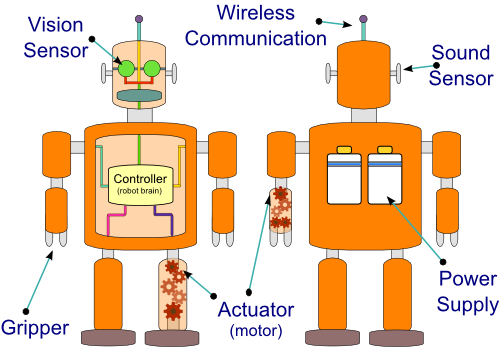
The above diagram shows a robot modelled on a human, often referred to as a humanoid. As you can see there are many parts that make up a robot, each of which can be designed in different ways depending on the purpose of the robot. The following sections will discuss these design considerations.A downloadable guide to Robotics can be found here.

Sensors


Lego NXT sensors
Lego NXT sensors
Multi-sensor mobile robot
Ultrasonic sensor module
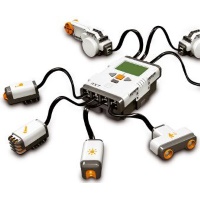
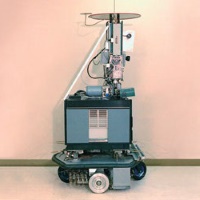
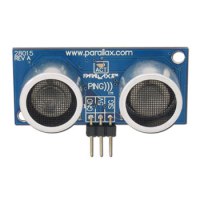
Robot sensors can be compared to our eyes, ears and sense of touch. Without sensors a robot has no way of perceiving its environment and can only perform predetermined tasks. There are two main types of sensors, those that sense the external world and those that sense the internal state of the robot. The following is a list of popular robot sensors:

External

  • Light Sensor
    • Often in the form of a light dependant resistor (LDR), depending on the intensity of the light, the resistance in the circuit changes. This can be used to sense the direction of a light source.
  • Contact Sensor
  • Proximity Sensor

Internal

  • Gyro – Used to keep the robot balanced
  • Accelerometer – For measuring movement
  • Temperature – For regulating the internal temperature of the robot

Tools and Attachments


Space shuttle manipulator
Robot gripper
Robot gripper
Early robot with packaging tool
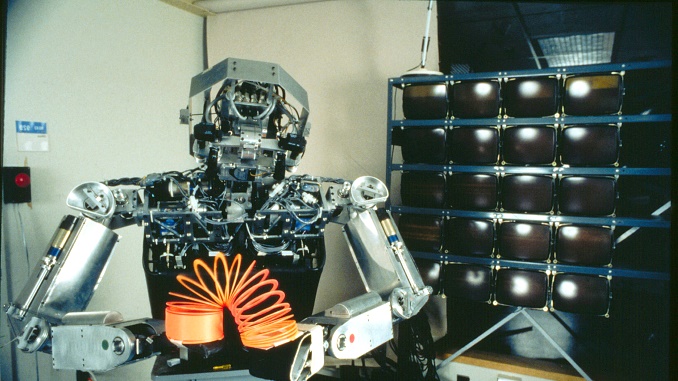
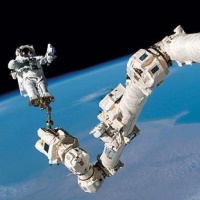
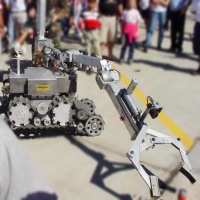
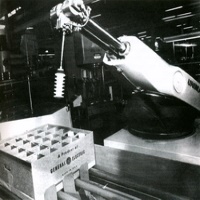
In robotics the tool or attachment at the end of a robotic arm is called an end effector. This end effector is used to interact with the environment, allowing the robot to carry out its task. The selection of the tool/attachment is dependent on the application of the robot; for example, robots used in car manufacturing often have interchangeable tools allowing the robot to complete various tasks, such as welding and paint spraying. Another example, often found in mobile Robots, is that of a universal-gripper, this type of attachment is much like a human hand and can be used to perform a variety of tasks such as picking-up objects, opening doors or pushing a switch.

Different Types of Robots


There are many different types of robots each designed for a specific task. Generally robots can be divided into two categories, those that operate in a fixed position and those that are mobile. Fixed robots are those which are anchored to a point and use manipulators such as arms to complete tasks. Many examples of fixed robots can be found in manufacturing where they are used for a variety of purposes, such as spray painting, welding, assembly and quality control. Mobile robots are designed to move around their environment using one or more wheels, legs or tracks, depending on the intended operating surface. The following is a list of the types of robots currently in use:
To Read More About Robotics, Click Here »

State of the Art Robots


To read about the latest Robots such as Honda’s ASIMO, Toyota’s Partner, PaPeRo the Personal Robot and many more take a look at our Robots page by clicking here                                                                          visit us on facebook

Thursday, September 12, 2019

How to Make a Robot - Lesson 1: Getting Started

visit us on facebook

RobotShop Grand Tutorial: How to Make a Robot - Lesson 1

Lessons Menu:

Getting Started
Welcome to the first installment of the Grand Robot Shop Tutorial, a series of 10 lessons that will teach you how to make your own robot. This tutorial is aimed at anybody willing to get started in robotics and have a basic understanding of terms such as “voltage”, “current”, “motor”, and “sensors”. Although this might seem pretty basic, even people with previous robot building experience might find useful information regarding the general method of building a robot.
What is a robot?
There are many definitions of robot and no real consensus has been attained so far. We loosely define a robot as follows:
Robot: An electromechanical device which is capable of reacting in some way to its environment, and take autonomous decisions or actions in order to achieve a specific task.
This means that a toaster, a lamp, or a car  would not be considered as robots since they have no way of perceiving their environment. On the other hand, a vacuum cleaner that can navigate around a room, or a solar panel that seeks the sun, can be considered as a robotic system. It is also important to note that the  “robots” featured in Robot Wars for instance or any solely remote controlled device would not fall under this definition and would be closer to a more complex remote controlled car. Although this definition is quite general, it might need to evolve in the future in order to keep up with the latest advancement in the field. In order to get a sens of how robotics is rapidly growing, we suggest you take a look at the Robot Shop History of Robotics.
Let's get started
This series of tutorials is intended to guide you through the steps of building a complete mobile robot. There are 10 lessons that will be released in the following 10 weeks.  Each lesson guides you through one step of making a general-purpose mobile robot.  This will enable you to build your very own mobile robot in order to perform a task of your choice. Each lesson will be illustrated with an example from Robot Shop experience in producing the Robot Shop Rover. The lessons are intended to be read one after the other and build upon the information gained.
The first step is to determine what your robot should do (i.e. what is its purpose in life). Robots can be used in almost any situation and are primarily intended to help humans in some way. If you are unsure of what you want your robot to do or simply want to concentrate your efforts on specific tasks, here are some ideas:

Knowledge & Learning

In order to build increasingly complex robots, most professionals and hobbyists use knowledge they have acquired when building previous robots. Instead of building one robot, you can learn how to use individual components with the objective of building your own "knowledge library" to use to undertake a larger, more complex design in the future.
LEGO Mindstorms NXT

Amusement & Companionship

Building a robot is in and of itself is fun and exciting. Robotics incorporates aspects of many disciplines including engineering (mechanical, electrical, computer), sciences (mathematics and physics) and arts (aesthetics) and users are free to use their imagination. Amusing others with your creations (especially if they are user-friendly and interactive) helps others to become interested in the field.
Teddy Bear Companion Robot

Competitions & Contests

Competitions give the project design guidelines and a due date. They also put your robot against others in the same class and test your design and construction skills. Although many competitions are specifically for students (elementary to university), there also exist open competitions where adults and professionals alike can compete.
Robot Soccer

Autonomous "life form"

Humans are natural creators and innovators. The next great innovation will be to develop a fully autonomous "life form" that rivals or surpasses ourselves in ability and perhaps creativity. This goal is still being accomplished in small steps by individuals, research organizations and professionals. Although you are likely just getting started in robotics, you will hopefully find creating basic autonomous behavior to be fun and interesting, and easier than you might have expected.
Alice Micro Robot Swarm

Domestic or Professional tasks

Domestic robots help liberate people from unpleasant or dangerous tasks and give them more liberty and security. Professional and Service Robots are used in a variety of applications at work, in public, in hazardous environments, in locations such as deep-sea, battlefields and space, just to name a few. In addition to the service areas such as cleaning, surveillance, inspection and maintenance, we utilize these robots where manual task execution is dangerous, impossible or unacceptable.  Professional and Service Robots are more capable, rugged and often more expensive than domestic robots and are ideally suited for professional and/or commercial use.
Neato Cleaning Tile Edge

Security and Surveillance

Most mobile robots are used to venture into areas where humans either should not or cannot go. Robots of various sizes (either remote controlled, semi-autonomous or fully autonomous) are an ideal choice for these tasks.  
SuperDroid HD2 SWAT / EOD Tactical Treaded Robot w / 5DOF Arm

Practical Example

We anticipate that most of you following this guide have the objective of building a robot for learning and knowledge, but also for sheer fun; though many will have a specific idea or project they want to materialize. The last major consideration is budget. It is difficult to know exactly what people have in mind when they build their first robot; one might already want to build an autonomous snow removal robot, while another simply wants to make an intelligent clock. A simple programmable mobile robot might cost about $100 while a more complex can be several thousands of dollars. In this exercise, we have chosen to make a mobile platform in order to get an understanding of motors, sensors, micro controllers and programming, and to include a variety of sensors. We’ll keep the budget to about $200 to $300 since we want it to be fairly complete.
Simple Mobile Robot CAD
visit us on facebook